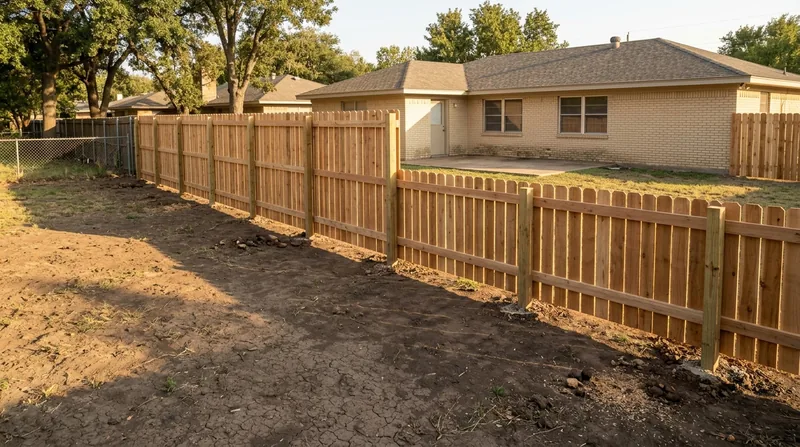




Privacy fence installation in Fort Worth means working with the land itself. The expansive clay soil that defines Greater Fort Worth heaves and shifts with every wet-then-dry cycle, and that movement is the reason most leaning fences fail within three to five years. We set posts deep enough and in concrete footings sized to resist that movement, not just to pass inspection. Cedar privacy fencing is the standard across Fort Worth, from the Heights bungalows to the ranch-belt neighborhoods of Wedgwood and beyond, and it demands installation that accounts for local soil conditions, not generic contractor shortcuts. Since 2010, we have installed and repaired wood and privacy fences across the Fort Worth area, and we know the difference between a fence that leans in year three and one that stands straight for fifteen years.
Why Wood and Privacy Fence Installation Matters in Fort Worth's Clay Soil
Fort Worth sits on expansive clay that swells when wet and shrinks when dry. A fence post set in tamped soil alone will heave within a few years as that clay moves beneath it. The post shifts up and sideways, the stringers rack, and the pickets no longer line up. What looks like a panel failure is almost always a post problem, not a picket problem. Proper installation means setting posts deep enough to anchor below the active clay layer and using concrete footings sized for that movement. The other critical factor is drainage: water pooling at the base of a post rots untreated wood at the ground line, a failure that accelerates in Fort Worth's humidity.
- We set posts deep enough to resist heave from expansive clay soil, not just to code minimum.
- Concrete footings are sized for the soil type and frost depth, ensuring the post stays in place through wet and dry cycles.
- We use pressure-treated pine or cedar, depending on budget and aesthetic preference, and both handle Fort Worth humidity when installed with proper drainage.
- Board-on-board and side-by-side configurations both work well here, and we help you choose based on wind exposure and privacy needs.
- Proper post spacing and anti-sag bracing prevent the racking that clay movement causes.
The difference between a fence that stands for fifteen years and one that leans by year three is in the footings, not the pickets.
Key info: Fort Worth's soil and humidity are not kind to corner-cutting. A homeowner in Arlington or Keller who installs a fence with shallow post holes or no concrete will watch it lean as the clay beneath shifts. That same homeowner with proper footings and drainage will have a straight fence that looks new for years. The upfront cost difference is small, the long-term difference is everything.
For more on what causes fence failure and how to prevent it, see our fence post repair and replacement service, where we diagnose and fix the posts that have already heaved.
How We Install Wood and Privacy Fences in Fort Worth: A Step-by-Step Process
Installation starts with a site walk to identify the fence line, check for utilities, and assess soil conditions and drainage. We then call 811 for a utility locate (required by Texas law before any digging), mark the line with the homeowner, and begin post placement. The footings are dug deep enough to anchor below the active clay layer, typically 30 to 36 inches depending on soil test and frost depth. Posts are set in concrete and checked for plumb and square. Rails are then attached, and pickets are installed either side-by-side or board-on-board, depending on your preference and the fence's exposure to wind.
- We conduct a site walk, identify the fence line from your existing survey or your direction, and check for buried utilities.
- We call 811 for a utility locate to ensure we avoid electric, gas, and water lines before digging any post holes.
- Post holes are dug to the depth required for Fort Worth's soil and climate, typically 30 to 36 inches, with concrete footings that resist heave.
- Each post is set in concrete, checked for plumb, and braced until concrete cures.
- Rails are attached using galvanized hardware, and pickets are installed in your chosen pattern: side-by-side, board-on-board, or custom spacing.
- We trim the top with cap and trim pieces for a finished look and to shed water away from the wood.
The entire process, from site walk to final inspection, typically takes one to two weeks for a standard residential fence, depending on length and site access.
Local example: A homeowner in Benbrook with a 150-linear-foot backyard fence needed a 6-foot privacy fence set back 6 inches from the property line to clear a utility easement. We dug post holes 36 inches deep, set posts in concrete 30 inches below grade, and installed 6-foot cedar pickets side-by-side with a 1-inch overlap. The fence was finished with galvanized cap and trim. Total time on site was eight working days. The homeowner's HOA required cedar, and the fence passed inspection because the posts were set properly and the line was clear.
If you need a gate as part of your fence, see our gate installation and repair service for details on self-closing hardware, cantilever versus V-track options, and post bracing for gate openings.
Wood and Privacy Fence Installation Methods and Materials
| Approach | Description | Best For |
|---|---|---|
| Cedar Privacy, Side-by-Side | Vertical cedar pickets installed flush against each other, creating a solid wall with no gaps. Posts are set in concrete 30 to 36 inches deep, rails are galvanized steel or cedar, and the top is finished with cap and trim. | Maximum privacy and wind resistance. Standard choice across Fort Worth residential neighborhoods and HOA communities. |
| Cedar Privacy, Board-on-Board | Pickets overlap by 1 to 2 inches on alternating sides of the rails, creating a staggered, solid appearance. Allows slight air flow while maintaining privacy. Posts and footings are identical to side-by-side. | Privacy with a refined look. Works well in neighborhoods where board-on-board is the HOA standard, such as Keller and Southlake. |
| Pressure-Treated Pine Privacy | Pressure-treated pine pickets and rails, installed side-by-side or board-on-board. Lower cost than cedar, and the treatment resists rot at the ground line. Posts are set in concrete footings. Requires staining every two to three years to maintain appearance. | Budget-conscious installations where durability and low maintenance cost are priorities. Works well for rear yards and side yards where aesthetics are secondary. |
| Racked or Stepped Installation on Sloped Ground | Posts are set plumb on sloped ground, and pickets are racked (angled) to follow the slope, or stepped in sections to maintain vertical pickets. Both methods keep the fence parallel to the ground rather than perpendicular to it. | Properties with significant grade change, such as lots in Arlington or North Richland Hills that back up to detention ponds or ravines. |
Wood and Privacy Fence Installation Cost in Fort Worth: What to Expect
Privacy fence installation costs in Fort Worth typically start at $24 per linear foot for pressure-treated pine and rise to $28 to $35 per linear foot for cedar, depending on board thickness, post spacing, and local labor rates. A 150-linear-foot cedar privacy fence with proper concrete footings, cap, and trim will run $4,200 to $5,250. The main cost drivers are the wood species (cedar versus pressure-treated pine), post depth and footing size (which are non-negotiable in Fort Worth clay), and site access. If the fence line runs through dense landscaping, poor access, or requires racking on a slope, labor increases. Soil conditions also matter: if we hit rock or caliche, digging costs more. We always recommend getting two or three estimates, not because price varies wildly, but because the scope of work and assumptions about footings and drainage can differ.
For a detailed pricing breakdown and examples of typical jobs, see our full pricing overview.
Wood and Privacy Fence Installation Near Me: What Fort Worth Homeowners Should Know Before Hiring
When you are looking for a fence contractor in Fort Worth or the surrounding areas, the most important questions are not about price alone. Start by asking whether the contractor has experience with Fort Worth's clay soil and whether they set posts in concrete footings sized for that soil type. Ask for references from jobs completed in the last two years, and follow up with at least one or two. Check whether the contractor is fully insured, and ask to see proof of insurance. If your property is in an HOA community, verify that the contractor understands your architectural standards for height, material, and color before work begins. If you are uncertain about setback requirements or corner-visibility rules, contact your city or county building department: those rules vary across Fort Worth, Arlington, Keller, and other cities in the area.
- Verify that the contractor sets posts in concrete footings deep enough for Fort Worth's expansive clay, not just to code minimum.
- Ask for references from residential fence projects completed in the last two years and follow up with at least one homeowner.
- Confirm that the contractor is fully insured, and request proof of coverage before signing a contract.
- If your property is in an HOA community, review the architectural guidelines with the contractor before work begins to avoid costly corrections.
- Check local setback and height rules with your city or county building department, as they vary across the Fort Worth area.
- Understand that permits may be required in some jurisdictions and not others, and the contractor should clarify this with you early.
A contractor who takes time to understand your soil, your property line, and your HOA rules is a contractor who will deliver a fence that lasts.
When you are ready to move forward, contact us for a free estimate. We will walk your property, discuss your goals, and give you a clear, honest assessment of what the work will cost and how long it will take.
Wood & Privacy Fence Installation in Fort Worth: Pricing Guide
| Service | Price | Details |
|---|---|---|
| Pressure-Treated Pine Privacy Fence | Starting at $24/ft | Posts set in concrete, side-by-side or board-on-board pickets, cap and trim included, typical for rear and side yards |
| Cedar Privacy Fence | Starting at $28/ft | Cedar pickets and rails, concrete footings, cap and trim, more durable than pine and the standard choice across Fort Worth HOA communities |
| Racked or Stepped Installation on Slope | Starting at $32/ft | Adapted post spacing and stepped picket layout for grade changes, requires additional labor and site assessment |
| Site with Poor Access or Utility Conflicts | On estimate | Dense landscaping, tight side yards, or utility lines require custom digging and routing, priced after site walk |
| Travel and Estimate | Included and Free | No separate call-out fee for Fort Worth and surrounding areas, free estimate with 24-hour response at (817) 632-6893 |
Indicative pricing, the exact cost depends on square footage, finish, and site access. Free personalized estimate within 24h at (817) 632-6893.


